
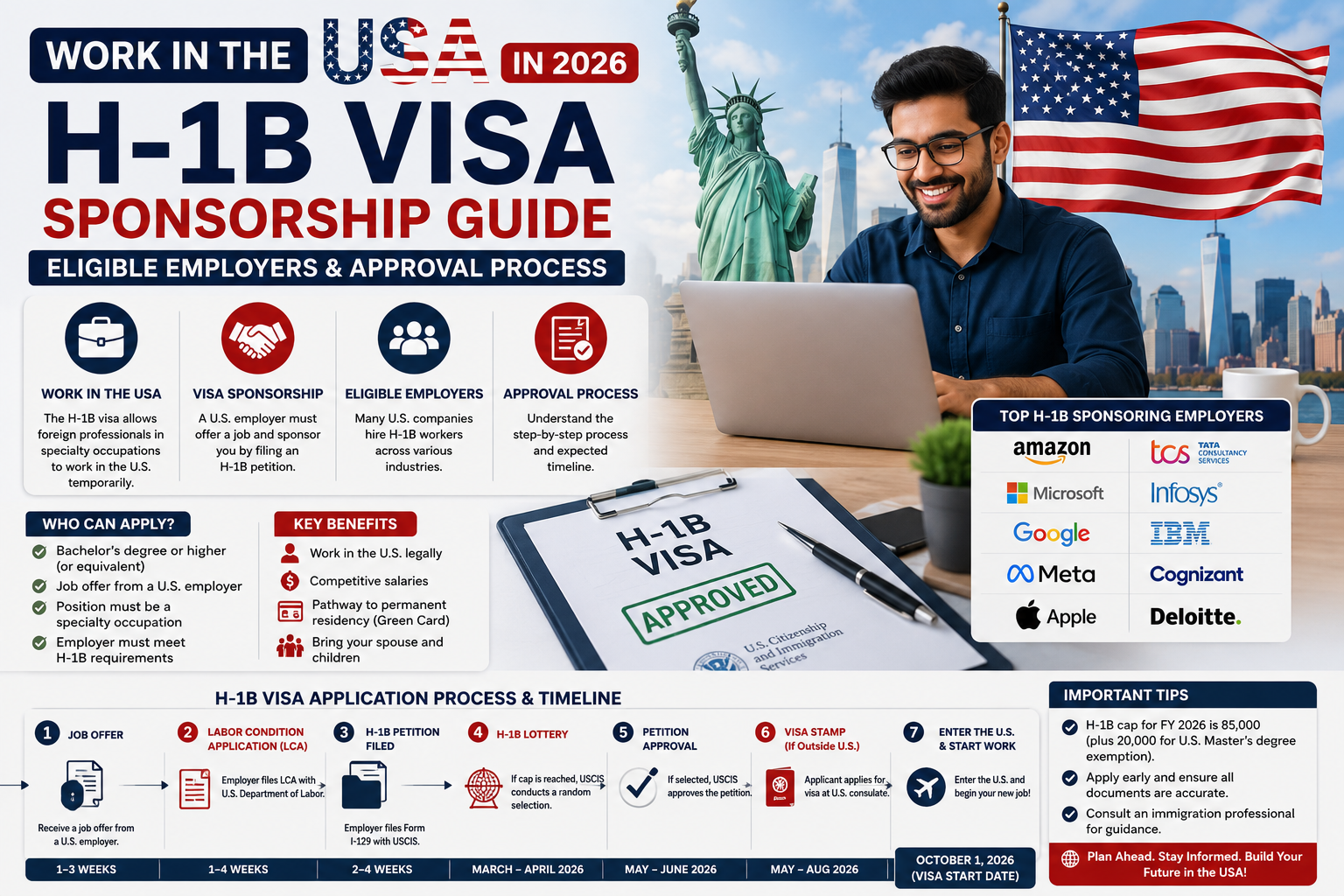
| Parameter / Metric | Regulatory & Operational Benchmark |
| Annual Statutory Cap | 85,000 Total (65,000 Regular Cap + 20,000 U.S. Master’s Degree Cap) |
| Electronic Registration Fee | $215 per beneficiary (Mandatory, non-refundable, paid by employer) |
| Selection Model | Beneficiary-Centric (Single entry per candidate regardless of registration count) + Wage-Level Weighted Entry |
| Primary Statutory Mandate | Role must qualify as a Specialty Occupation requiring at least a relevant bachelor’s degree |
| Sponsorship Cost Allocation | All legal, petition, and government fees must be paid by the sponsoring employer |
The U.S. H-1B visa remains the core employment-based visa for foreign professionals working in specialized industries. Securing sponsorship requires navigating a structured, time-sensitive process governed by U.S. Citizenship and Immigration Services (USCIS) and the U.S. Department of Labor (DOL).
1. Specialty Occupation Criteria & Eligibility
To qualify for an H-1B visa, the open role and candidate must satisfy three legal baseline requirements:
-
Educational Attainment: The candidate holds a U.S. bachelor’s degree (or higher) or its foreign academic equivalent.
-
Specialty Occupation Standard: The candidate’s position requires theoretical and practical application of a body of highly specialized knowledge.
-
Degree-to-Role Direct Alignment: The candidate’s major field of study directly aligns with the specific job responsibilities of the position.
                [ Employer Job Offer ]
                          │
  ┌───────────────────────┴───────────────────────┐
  ▼                                               ▼
[ Specialty Occupation ]               [ Candidate Qualifications ]
• Degree required for entry             • Relevant Bachelor's/Master's
• Complex, specialized duties           • Foreign credential evaluation
• Aligns with OEWS/SOC codes            • Direct academic fit for role
Qualifying Sectors & Typical Roles
-
Technology & Data: Software Engineers, Data Scientists, Cybersecurity Analysts, Systems Architects.
-
Engineering & Hardware: Civil, Mechanical, Biomedical, and Semiconductor Engineers.
-
Finance & Analytics: Quantitative Analysts, Financial Risk Managers, Actuaries.
-
Healthcare & Life Sciences: Clinical Researchers, Biostatisticians, Medical Specialists.
2. Lottery Selection Dynamics: Beneficiary-Centric & Wage Weighting
The annual lottery operates under regulatory mechanisms designed to enforce system integrity:
A. Beneficiary-Centric Selection
-
Passport-Based Identification: Every applicant is entered into the USCIS registration system using a unique passport or travel document number.
-
Single Selection Entry: If multiple employers submit valid registrations for the same individual, that individual is entered into the selection pool as one unique beneficiary.
B. OEWS Wage Level Weighting System
Selection probability is calibrated against the Occupational Employment and Wage Statistics (OEWS) prevailing wage tier offered by the petitioning employer:
| OEWS Wage Level | Skill & Experience Classification | Lottery Weighting Multiplier |
| Wage Level I | Entry Level (Basic knowledge, close supervision) | 1x Entry |
| Wage Level II | Qualified (Moderate experience, independent execution) | 2x Entries |
| Wage Level III | Experienced (Advanced technical skills, supervisory) | 3x Entries |
| Wage Level IV | Fully Competent (Senior leadership, expert command) | 4x Entries |
Note: If a single candidate receives multiple job offers registered at different wage levels, USCIS defaults the candidate’s selection weighting to the lowest registered wage level tier among the submissions.
3. Cap-Exempt Employers: Bypassing the Lottery
Certain categories of employers are statutorily exempt from the 85,000 annual cap and can submit H-1B petitions at any point during the year without entering the lottery:
-
Higher Education Institutions: Public and private accredited universities and colleges.
-
Nonprofit Entities Affiliated with Higher Education: Research hospitals, teaching facilities, and university-linked labs.
-
Nonprofit & Governmental Research Organizations: Entities primarily engaged in basic or applied scientific research.
4. Operational H-1B Timeline
[ MARCH ] ──────────────► [ LATE MARCH ] ─────────────► [ APRIL 1 – JUNE 30 ] ────────► [ OCT 1 ]
Electronic Registration     Lottery Selection          Petition Filing Window          Work Start
Window ($215 Fee)           Notifications Issued       (LCA + Form I-129)              Date
-
March: Employer opens a USCIS organizational account, registers the prospective employee, and pays the $215 registration fee.
-
Late March: USCIS runs the selection algorithm and issues electronically signed selection notices.
-
April 1 – June 30: Selected employers submit a certified Labor Condition Application (LCA) to the Department of Labor and file Form I-129 (Petition for Nonimmigrant Worker) with USCIS.
-
October 1: The official start date for approved cap-subject H-1B employment for that fiscal year.
5. Employer Fee Allocations vs. Employee Costs
Federal law strictly defines financial responsibility for H-1B filings to prevent cost-shifting to foreign workers.
| Cost Category | Fee Amount | Obligated Party |
| Electronic Registration Fee | $215 | Employer (Mandatory) |
| Base Form I-129 Filing Fee | $460 – $780 | Employer (Mandatory) |
| Asylum Program Fee | $300 – $600 | Employer (Mandatory) |
| ACWIA Training Fee | $750 – $1,500 | Employer (Mandatory by law) |
| Fraud Prevention & Detection Fee | $500 | Employer (Mandatory on initial filings) |
| Premium Processing (Form I-907) | $2,805 | Employer or Employee (15-day expedited adjudication) |
| Consular Processing & Visa Stamping | $205 + Reciprocity | Employee |
Prohibited Practice: Sponsoring employers cannot require foreign workers to pay or reimburse them for statutory filing fees, legal expenses, or ACWIA training costs.
6. Long-Term Validity & Green Card Transition
-
Initial Status: Granted for up to 3 years, renewable once for a total maximum limit of 6 years.
-
Mobility / Employer Transfers: H-1B workers can change employers via an “H-1B Transfer” filing without undergoing the lottery again, provided they remain in lawful status.
-
Extensions Beyond 6 Years:
-
1-Year Extensions: Permitted if an EB-2/EB-3 PERM Labor Certification or Form I-140 petition was filed at least 365 days prior to reaching the 6-year cap.
-
3-Year Extensions: Permitted if the beneficiary holds an approved Form I-140 but cannot file for adjustment of status due to green card backlog quota delays.
-
