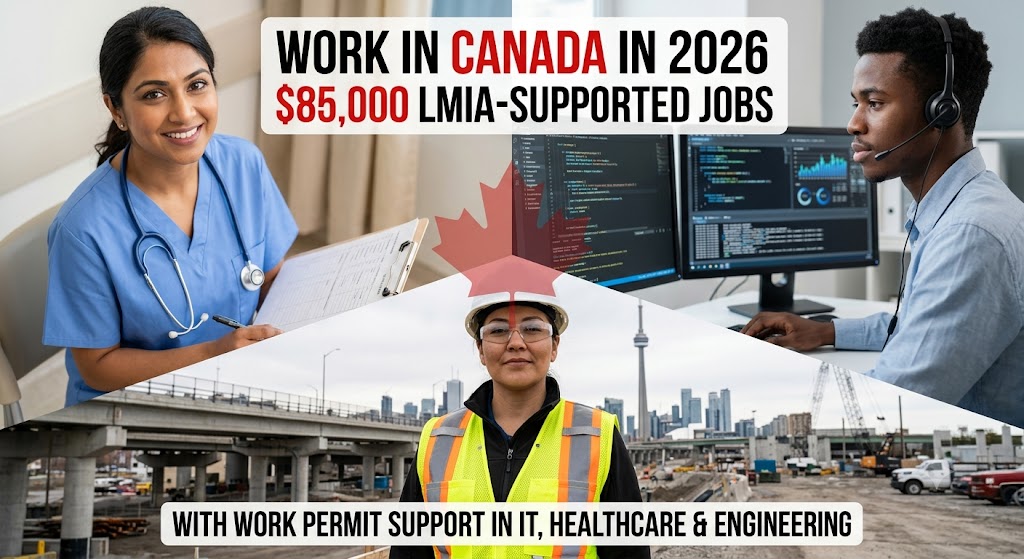
| SALARY | POSITION TYPE | EMPLOYMENT TYPE |
|---|---|---|
| UP TO $85,000 CAD | LMIA-SUPPORTED | FULL-TIME / PERMANENT OR CONTRACT |
Finding a well-paid job in Canada can be an attractive option for skilled professionals around the world. In 2026, employers in sectors such as information technology, healthcare, engineering, construction, transportation, and other specialized fields may recruit qualified foreign workers when they cannot fill certain positions locally.
For many international applicants, an LMIA-supported job can provide an important route toward obtaining an employer-specific Canadian work permit.
This guide explains how LMIA-supported employment works, which industries may offer opportunities, what qualifications employers typically look for, and what international workers should know before applying.
IMPORTANT: An LMIA is not a visa or work permit. It is an assessment that an employer may need before hiring a foreign worker. After the employer receives a positive LMIA, the foreign worker generally needs to apply for the appropriate work permit and meet all applicable Canadian immigration requirements.
1. WHY CONSIDER LMIA-SUPPORTED JOBS IN CANADA IN 2026?
Canada continues to rely on immigration and temporary foreign-worker programs to address labour needs in specific occupations and regions.
Under the Temporary Foreign Worker Program (TFWP), an employer may need to obtain a Labour Market Impact Assessment (LMIA) before hiring a foreign worker. Employment and Social Development Canada (ESDC) assesses whether hiring the foreign worker is likely to have a positive or neutral impact on Canada’s labour market.
For qualified international professionals, an LMIA-supported position can potentially provide:
- An opportunity to work legally in Canada.
- An employer-specific work permit pathway.
- Canadian work experience.
- Competitive wages depending on the occupation and location.
- Potential opportunities to qualify for permanent residence through separate immigration programs.
However, receiving an LMIA does not automatically guarantee a work permit, permanent residence, or a visa. Applicants must still satisfy the requirements of Immigration, Refugees and Citizenship Canada (IRCC) and any applicable provincial or territorial authorities.
WHERE ARE THE OPPORTUNITIES?
Job opportunities are available across Canada, not only in Toronto and Vancouver.
Depending on the occupation and employer, international professionals may find opportunities in cities and regions such as:
- Calgary, Alberta
- Edmonton, Alberta
- Ottawa, Ontario
- Halifax, Nova Scotia
- Montreal, Quebec
- Winnipeg, Manitoba
- Saskatoon, Saskatchewan
- Kitchener-Waterloo, Ontario
- Victoria, British Columbia
- Toronto, Ontario
The availability of LMIA-supported positions changes frequently, so applicants should verify the employer, occupation, wage, location, and immigration requirements before applying.
2. HIGH-DEMAND SECTORS FOR INTERNATIONAL WORKERS
LMIA-supported opportunities can exist across numerous industries. Three sectors that frequently attract skilled international professionals include IT, healthcare, and engineering.
IT JOBS IN CANADA
Canada’s technology industry continues to create opportunities for experienced professionals in areas such as:
- Software development
- Cybersecurity
- Cloud computing
- Data science
- Artificial intelligence
- DevOps
- Network administration
- Database administration
- Information systems
Depending on the occupation and employer, qualified technology professionals may be considered under different immigration programs, including specialized streams such as the Global Talent Stream.
Eligibility and processing requirements vary by position, employer, and immigration pathway.
HEALTHCARE JOBS IN CANADA
Healthcare remains an important employment sector across many Canadian provinces and territories.
Potential opportunities may include:
- Registered nurses
- Licensed practical nurses
- Medical laboratory professionals
- Healthcare assistants
- Medical technologists
- Physiotherapists
- Pharmacists
- Other healthcare specialists
Healthcare professionals should understand that many occupations are regulated in Canada. Having an overseas qualification does not necessarily mean that an applicant can immediately practise their profession.
Applicants may need to complete credential assessments, examinations, registration, licensing, language requirements, or provincial regulatory processes before working in a regulated healthcare occupation.
ENGINEERING JOBS IN CANADA
Engineering and infrastructure projects can create opportunities for qualified professionals in areas such as:
- Civil engineering
- Mechanical engineering
- Electrical engineering
- Industrial engineering
- Software engineering
- Environmental engineering
- Mining engineering
- Petroleum and energy-related engineering
Some engineering positions are regulated, meaning applicants may need approval or licensing from the appropriate provincial or territorial engineering regulator.
3. SALARY AND BENEFITS: WHAT CAN YOU EXPECT?
A salary of $85,000 CAD per year can be competitive for many professional positions, but actual compensation depends on the occupation, employer, province, experience, and prevailing wage requirements.
For example, an $85,000 annual salary represents approximately:
$7,083 CAD gross per month
before taxes and other deductions.
Your actual take-home pay will depend on factors including:
- Federal income tax
- Provincial or territorial income tax
- Canada Pension Plan (CPP) contributions
- Employment Insurance (EI) premiums
- Other payroll deductions
- Your province or territory of residence
- Your personal tax circumstances
SAMPLE COMPENSATION STRUCTURE
| COMPENSATION | EXAMPLE VALUE |
|---|---|
| Annual Gross Salary | $85,000 CAD |
| Approximate Monthly Gross Salary | $7,083 CAD |
| Income Tax | Varies |
| CPP | Varies by year and earnings |
| EI | Varies by year and earnings |
| Net Monthly Income | Depends on personal circumstances |
| Health Benefits | Depends on employer |
| Relocation Assistance | Only if offered |
| Retirement Benefits | Only if offered |
Important: Do not assume that every employer offering an LMIA-supported position will provide relocation assistance, private health insurance, retirement matching, flight tickets, accommodation, or other benefits.
These benefits must be confirmed directly in the employment contract or official job offer.
4. HOW DOES THE LMIA PROCESS WORK?
The LMIA process involves both the Canadian employer and the foreign worker.
In many cases, the employer must first demonstrate to ESDC that there is a legitimate need for a foreign worker and that hiring the worker will comply with the requirements of the Temporary Foreign Worker Program.
A simplified process may look like this:
STEP 1: FIND A LEGITIMATE CANADIAN EMPLOYER
The applicant finds an employer offering a position that matches their qualifications and experience.
STEP 2: THE EMPLOYER COMPLETES THE LMIA PROCESS
Where an LMIA is required, the employer applies to ESDC and provides the required information about the position, recruitment efforts, wages, working conditions, and business.
STEP 3: POSITIVE LMIA
If ESDC approves the application, the employer receives a positive LMIA decision.
STEP 4: APPLY FOR A WORK PERMIT
The foreign worker can then use the required employment and LMIA documentation to apply to IRCC for the appropriate work permit.
STEP 5: MEET IRCC REQUIREMENTS
The applicant must satisfy all applicable requirements, which can include proof of qualifications, work experience, identity documents, admissibility requirements, and other supporting documentation.
STEP 6: BEGIN WORK IN CANADA
If the work permit is approved, the worker can travel to Canada and work according to the conditions of their permit.
5. DOES AN LMIA GUARANTEE PERMANENT RESIDENCY?
No.
An LMIA-supported job does not automatically lead to Canadian permanent residence.
However, Canadian work experience and skilled employment may help an eligible worker qualify for certain permanent-residence programs.
Potential pathways can include:
- Express Entry programs
- Provincial Nominee Programs (PNPs)
- Canadian Experience Class, where the applicant meets the requirements
- Other federal or provincial immigration pathways
Immigration rules and program requirements can change, so applicants should check the latest requirements through the official Government of Canada website before making decisions.
IMPORTANT CHANGE TO EXPRESS ENTRY
Applicants should be careful with older online information claiming that an LMIA-supported job offer automatically adds 50 or 200 CRS points.
As of March 25, 2025, IRCC removed CRS points for job offers from the Express Entry Comprehensive Ranking System.
An LMIA can still be relevant to certain immigration and work-permit processes, but applicants should not calculate their current Express Entry score using the former job-offer CRS bonus.
6. WHO CAN APPLY FOR LMIA-SUPPORTED JOBS?
International applicants from countries around the world may apply for Canadian positions if they meet the employer’s requirements and the applicable immigration rules.
Employers may consider factors such as:
EDUCATION
Depending on the occupation, employers may require:
- A university degree
- College diploma
- Professional qualification
- Trade certification
- Relevant technical training
For immigration or licensing purposes, applicants may also need an educational credential assessment or other form of credential recognition.
WORK EXPERIENCE
Many professional positions require previous experience in the same or a closely related occupation.
Your experience should accurately match the duties and requirements of the position.
LANGUAGE SKILLS
Depending on the job and immigration pathway, applicants may need to demonstrate proficiency in English or French through an approved language test.
Common tests include:
- IELTS
- CELPIP
- PTE Core
- TEF Canada
- TCF Canada
The specific test and required score depend on the immigration program and circumstances.
PROFESSIONAL LICENSING
Some Canadian occupations are regulated.
Healthcare professionals, engineers, tradespeople, and other regulated workers may need provincial or territorial licensing before they can practise.
Having an employment offer does not automatically provide professional authorization.
7. DOCUMENTS YOU MAY NEED
Applicants should be prepared to provide documentation supporting their identity, qualifications, experience, and employment history.
Depending on the position and immigration pathway, documents may include:
- Valid passport
- Resume/CV
- Employment reference letters
- Educational certificates
- Transcripts
- Professional licenses or registrations
- Language test results
- Employment offer
- LMIA documentation, where applicable
- Police certificates, where required
- Medical examination results, where required
- Proof of funds, where applicable
Always provide truthful and verifiable information.
False documents, misleading information, or misrepresentation can lead to serious immigration consequences.
8. HOW TO FIND LEGITIMATE LMIA-SUPPORTED JOBS
Finding a legitimate employer is one of the most important parts of the process.
Applicants should search through reputable sources, including:
- The Government of Canada’s Job Bank
- Official company career pages
- Established recruitment agencies
- Provincial employment portals
- Professional associations
- Reputable industry-specific job boards
When reviewing a job advertisement, check:
- The company’s legal name.
- The employer’s official website.
- The job location.
- The salary and working conditions.
- The occupation and duties.
- The application process.
- Whether the employer actually supports foreign-worker applications.
Be cautious about social-media accounts or individuals promising guaranteed Canadian jobs or visas.
9. BEWARE OF LMIA AND VISA SCAMS
You should never assume that paying someone guarantees an LMIA or Canadian work permit.
A legitimate employer should provide clear information about the position, employment conditions, and recruitment process.
Be particularly cautious if someone:
- Guarantees a Canadian visa.
- Guarantees permanent residence.
- Promises an LMIA without a genuine job.
- Requests large payments in exchange for a job offer.
- Asks you to falsify documents.
- Uses unofficial email addresses while claiming to represent a major company.
- Refuses to provide a written employment agreement.
- Pressures you to send money immediately.
The LMIA application process is primarily the employer’s responsibility, and employers generally cannot simply transfer the LMIA processing fee to the foreign worker.
10. FINAL THOUGHTS
An $85,000 CAD job in Canada can be an attractive opportunity for qualified international professionals, particularly in areas such as IT, healthcare, engineering, and other specialized occupations.
However, applicants should understand the difference between an LMIA, a work permit, and permanent residence.
An LMIA is not a visa, and an LMIA-supported job does not guarantee immigration approval or permanent residence.
The safest approach is to:
- Find a genuine Canadian employer.
- Verify the job and employer.
- Confirm whether an LMIA is actually required.
- Check the applicable wage and occupation requirements.
- Prepare accurate documentation.
- Follow IRCC and ESDC requirements.
- Use an authorized immigration professional if you need personalized legal advice.
With the right qualifications, a genuine job offer, and a properly completed immigration application, working in Canada can become a realistic career opportunity for eligible international workers.
Always verify current requirements through official Government of Canada sources before paying fees, accepting an offer, or submitting an immigration application.