
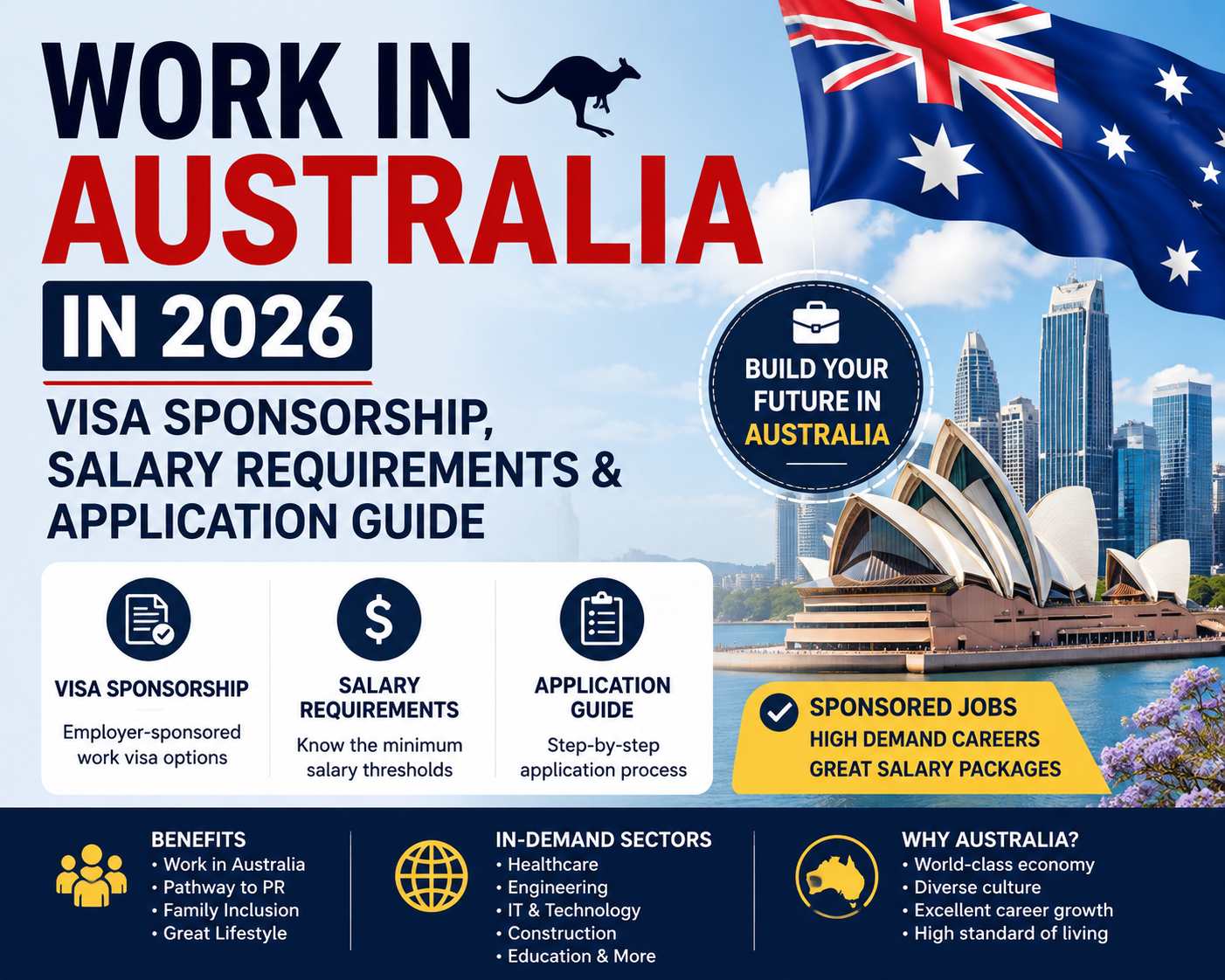
| Key Metric / Parameter | 2026 Benchmark & Regulatory Standard |
| Primary Temporary Work Visa | Skills in Demand (SID) Visa (Subclass 482) |
| Core Skills Income Threshold (CSIT / TSMIT) | AUD $79,499 / year + superannuation (Must also meet Annual Market Salary Rate if higher) |
| Specialist Skills Income Threshold (SSIT) | AUD $146,717 / year + superannuation |
| Work Experience Requirement | 1 year of relevant full-time experience (within the past 5 years) |
| Sponsor Switching Grace Period | 180 days job mobility window to transfer sponsors |
| Permanent Residency (PR) Pathway | Subclass 186 (ENS) after 2 years of sponsored employment |
Australia’s employer-sponsored skilled migration system provides international professionals with direct employment, competitive wages, and a clear pathway to permanent residency. Following major migration reforms, the Skills in Demand (SID) Visa (Subclass 482) serves as the primary temporary entry route, replacing the former TSS visa.
1. Primary Employer-Sponsored Visa Categories
Employer sponsorship in Australia operates across three principal visa subclasses:
                  [ Australia Employer Sponsorship Pathways ]

[ Skills in Demand (Subclass 482) ]  [ Employer Nomination Scheme (186) ]  [ Regional Sponsored (Subclass 494) ]
• Temporary (Up to 4 Years)         • Direct Permanent Residency (PR)     • Regional Provisional (5 Years)
• 3 Streams: Core, Specialist, Labor • TRT Stream after 2 Years on SID 482 • Requires 3 Years for Subclass 191 PR
1. Skills in Demand (SID) Visa (Subclass 482)
A temporary work visa granted for up to 4 years (5 years for Hong Kong passport holders). It is split into three streams:
-
Core Skills Stream: For occupations listed on the Core Skills Occupation List (CSOL), paying at or above the Core Skills Income Threshold (CSIT).
-
Specialist Skills Stream: Accelerated processing for high earners across most professional ANZSCO occupations (excluding trades, machinery operators, and manual labor).
-
Labour Agreement Stream: For specialized industries operating under negotiated government labor agreements.
2. Employer Nomination Scheme (Subclass 186)
A direct Permanent Residency (PR) visa. Applicants can qualify via the Temporary Residence Transition (TRT) stream after completing 2 years of full-time work with their sponsoring employer on a Subclass 482 visa, or via the Direct Entry stream with a formal skills assessment and 3 years of work experience.
3. Skilled Employer Sponsored Regional Visa (Subclass 494)
A 5-year provisional visa requiring applicants to live and work in designated regional areas outside Sydney, Melbourne, and Brisbane. It provides a direct pathway to permanent residence via the Subclass 191 visa after 3 years.
2. Mandatory Salary Thresholds & Wage Protections
To protect local wage standards and prevent migrant underpayment, Australia enforces two mandatory salary tests:
-
National Income Threshold Floor (CSIT / SSIT):
-
Core Skills Stream / Subclass 494: Minimum base salary of AUD $79,499 per year.
-
Specialist Skills Stream: Minimum base salary of AUD $146,717 per year.
-
-
Annual Market Salary Rate (AMSR):
-
Employers must prove that the sponsored worker is being paid the genuine market rate for an equivalent Australian worker in the same role and location.
-
Rule: Sponsoring employers must pay whichever figure is higher between the AMSR and the official income threshold floor.
-
3. Applicant Eligibility Criteria & Key Benefits
To qualify for an employer-sponsored skilled visa, candidates must satisfy the following core requirements:
-
Work Experience: Minimum of 1 year of full-time, relevant work experience within the last 5 years (reduced from the historical 2-year standard).
-
English Language Proficiency: Pass an approved English test (e.g., IELTS, PTE Academic, TOEFL iBT) achieving required score benchmarks unless exempt by nationality or prior study.
-
Skills Assessment: Positive skills assessment from the designated assessing authority if specified for the nominated occupation or stream.
-
Health & Character: Pass panel physician medical examinations and present police clearance certificates for every country lived in for 12+ months over the past decade.
-
Job Mobility (180-Day Rule): If sponsored employment terminates, visa holders have up to 180 days (and up to 360 days total across the visa duration) to secure a new sponsor, switch roles, or arrange departure, during which time they retain full work rights.
4. Employer Requirements & Sponsorship Workflow
Australian employers must be accredited before sponsoring overseas talent:
STEP 1: Standard Business Sponsorship (SBS)
Approved as a lawful, operating business in Australia (Valid for 5 years).

STEP 2: Position Nomination
Employer submits job details, proves Labour Market Testing (LMT), and pays the SAF Levy.

STEP 3: Visa Application
Overseas worker lodges individual visa application linked to the approved nomination.
-
Labour Market Testing (LMT): Employers must demonstrate they advertised the position locally within required timeframes prior to nominating an overseas applicant.
-
Skilling Australians Fund (SAF) Levy: A non-refundable government tax paid by the employer upon lodging a nomination:
-
Turnover under AUD $10M: AUD $1,200 per year per worker.
-
Turnover AUD $10M or higher: AUD $1,800 per year per worker.
-
5. Required Document Checklist
For the Applicant:
-
Identification: Valid passport and national identity documents.
-
Employment Offer: Signed employment contract showing job title, base salary (meeting CSIT/SSIT standards), and duty statement.
-
Work Experience Verification: Payslips, tax records, employer reference letters, and contracts proving at least 1 year of relevant experience.
-
Qualifications: Academic degrees, diplomas, and official transcripts.
-
Skills & Language: Positive skills assessment (if applicable) and English language test scorecard.
-
Clearances: Police checks and completed health assessments.
6. Frequently Asked Questions (FAQs)
Q: Can I bring my family on an employer-sponsored work visa?
Yes. Spouses/de facto partners and dependent children can be included in the application. Spouses receive unrestricted work rights in Australia upon visa grant.
Q: How long does it take to get Permanent Residency via employer sponsorship?
Under the Subclass 482 (SID) to Subclass 186 (TRT) pathway, visa holders are eligible to apply for PR after 2 years of full-time employment with their sponsoring employer.
Q: Who pays the visa application and sponsorship fees?
Australian law mandates that the sponsoring employer must pay all sponsorship approval fees, nomination fees, and SAF levies. Employers are strictly prohibited from transferring these costs to the foreign worker. The worker typically pays their own individual visa application fee, health exams, and police checks unless covered by an employer relocation package.
Q: What happens if my sponsoring employer goes out of business?
Under the 180-day mobility rule, you have 180 consecutive days to find a new approved Australian business to lodge a new nomination for your role. You may continue working during this transition period.
