
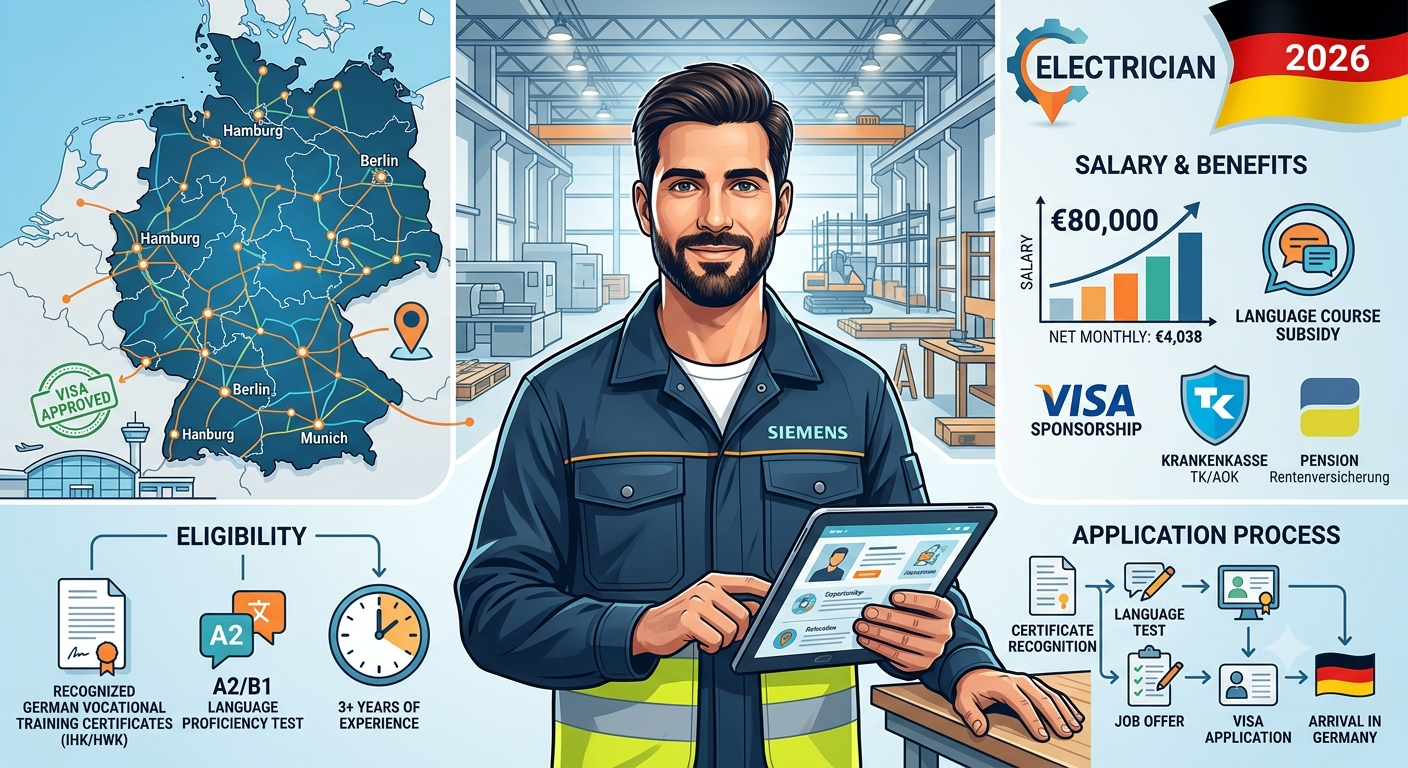
| Key Details | Visa Route | Position Type |
| €80,000 EUR | Employer-Sponsored | Full-Time Permanent |
Securing electrician jobs in Germany with visa sponsorship is one of the most reliable and high-paying pathways for skilled trade professionals looking to relocate in 2026. This comprehensive guide covers everything from navigating the official recognition process (Anerkennung) to calculating net take-home pay and securing permanent European residency.
1. Why Pursue Electrician Jobs in Germany with Visa Sponsorship in 2026?
The German industrial and construction sectors face unprecedented labor shortages, driven heavily by the nationwide shift toward renewable energy and infrastructure modernization. Revisions to the Skilled Immigration Act (Fachkräfteeinwanderungsgesetz) have significantly lowered barriers for foreign trade professionals.
Key Industry Insight: The German electrical and HVAC sectors currently report over 80,000 unfilled vacancies, prompting industrial employers to recruit globally, assist with visa processing, and offer comprehensive relocation support.
Whether targeting hubs like Stuttgart, Munich, Dortmund, Leipzig, or Bremen, demand for industrial electricians and solar energy technicians remains at an all-time high.
2. Key Responsibilities & Core Expectations
Working as a qualified tradesperson in the DACH region requires strict adherence to technical and safety regulations (such as VDE regulations and DIN standards).
-
Installation & Maintenance: Assemble and maintain high-voltage industrial systems or commercial solar grids.
-
Regulatory Compliance: Ensure all installations strictly comply with VDE safety guidelines and local DIN codes.
-
System Diagnostics: Troubleshoot automated manufacturing lines, robotics, and Programmable Logic Controllers (PLCs).
-
Collaborative Oversight: Partner with site managers and engineering teams in dynamic production environments.
3. €80,000 Compensation Breakdown & Net Take-Home Pay
To evaluate your offer accurately, calculate your expected net monthly pay after mandatory Lohnsteuer (income tax) and statutory German social security deductions.
| Compensation Element | Value (EUR) | Notes / Deductions |
| Base Annual Earnings | €80,000 | Exceeds general visa salary baselines |
| Income Tax (Lohnsteuer) | -€18,500 | Estimated annual deduction (Tax Class 1) |
| Pension (Rentenversicherung) | -€7,440 | Mandatory public pension insurance (approx. 9.3%) |
| Health Insurance (Krankenkasse) | -€3,200 | Statutory contribution (e.g., TK, AOK) |
| Unemployment (Arbeitslosenversicherung) | -€1,040 | Mandatory statutory contribution |
| Long-Term Care (Pflegeversicherung) | -€1,360 | Mandatory long-term care insurance |
| Estimated Net Monthly Pay | ~€4,038 | Net monthly take-home salary |
| Added Value & Sponsorship Perks | ||
| Relocation Allowance | +€3,500 | Assistance for flights & temporary housing |
| Language Course Subsidy | +€1,500 | Employer-funded Goethe-Institut or TELC classes |
| Visa Processing Fees Covered | +€600 | Covered directly by the employer |
| Total Value Package | €85,600 | Comprehensive annual package value |
4. Visa Routes for Foreign Trade Professionals
Navigating the Federal Office for Migration and Refugees (BAMF) and the local Foreigners’ Authority (Ausländerbehörde) involves three main pathways:
-
Germany Skilled Worker Visa (Fachkräftevisa): For professionals with recognized qualifications and a direct job offer.
-
Recognition Partnership Visa: Allows you to enter Germany and start working while your foreign credentials complete official assessment.
-
Opportunity Card (Chancenkarte): A points-based system for job seekers to enter Germany and look for employment locally.
5. Eligibility Criteria for Overseas Applicants
Essential Requirements
-
Credential Recognition: A completed vocational training certificate formally recognized via the Anerkennung process by the Chamber of Commerce (IHK) or Chamber of Crafts (HWK).
-
Job Offer: A binding employment contract from a registered German employer.
-
Language Skills: Basic-to-intermediate German proficiency (A2/B1 level certified via Goethe-Institut or TELC).
Highly Desirable Factors
-
3+ years of verifiable technical experience as an industrial electrician, welder, or CNC machinist.
-
Specialized certifications in high-demand fields (e.g., photovoltaics, heat pumps, automation).
6. Top Licensed Employers & Recruitment Agencies
| Employer / Agency | Industry Sector | Organization Type |
| Siemens AG | Industrial Manufacturing & Automation | Employer |
| Robert Bosch GmbH | Engineering & Technology | Employer |
| E.ON / RWE | Renewable Energy & Power Utilities | Employer |
| SPIE Deutschland & Central Europe | Energy & Technical Facility Services | Employer |
| Goldbeck | Commercial Construction & Engineering | Employer |
| Hays Germany / Randstad Germany | Engineering & Skilled Trades Recruitment | Agency |
| König GmbH / TEMPTON | Industrial & Technical Staffing Specialists | Agency |
Job Search Tip: Search for open opportunities via de.indeed.com, jobs.arbeitsagentur.de (Federal Employment Agency), and LinkedIn Jobs.
7. Cost of Living & Financial Planning
Establishing a German bank account (e.g., N26, Deutsche Bank, Commerzbank) early ensures smooth payroll processing. For sending money to family abroad, compare rates using platforms like Wise, Remitly, or WorldRemit.
Monthly Budget Comparison (Nuremberg Example)
| Expense Category | Standard Resident | Subsidized Relocation |
| Rent / Housing | €1,200 | €800 (employer-assisted) |
| Utilities & Heating | €250 | €200 |
| Groceries | €400 | €400 |
| Local Transport | €49 (Deutschlandticket) | €0 (company vehicle provided) |
| Total Monthly Expenses | €1,899 | €1,400 |
8. Step-by-Step Application Roadmap
-
Qualification Assessment: Initiate the Anerkennung process via the official “Make it in Germany” portal to evaluate your credentials with the IHK or HWK.
-
Language Certification: Complete an approved German language exam (Goethe-Institut or TELC) to reach at least A2/B1 level.
-
Format Your Application: Prepare a German-standard CV (Europass) highlighting certifications, safety standards, and practical experience.
-
Apply for Roles: Target licensed employers via de.indeed.com and specialized technical recruitment agencies.
-
Visa Processing: Apply for your Fachkräftevisa or Recognition Partnership Visa through your local German embassy.
9. Frequently Asked Questions
Q: Can applicants from non-EU countries like Nigeria, India, the Philippines, or Jamaica apply?
Yes. Tradespeople from any country outside the EU are fully eligible, provided their vocational training passes the German qualification recognition (Anerkennung) process.
Q: Do I need a university degree to qualify?
No. University degrees are not required for trade roles. However, a formal apprenticeship or vocational diploma recognized by German authorities (IHK/HWK) is mandatory.
Q: Does this lead to permanent residency?
Yes. Under the Skilled Worker Visa, you can generally apply for a permanent settlement permit (Niederlassungserlaubnis) after 3 to 4 years of continuous employment and pension contributions.
