
| Key Benchmark | Details & Requirements |
| Salary Range | $38,000 – $52,000+ CAD / year ($18.50 – $26.00+ / hour) |
| Primary Visa Routes | Temporary Foreign Worker Program (LMIA) · Provincial Nominee Programs (PNP) |
| NOC Code Targets | NOC 33102 (Nurse Aides/Orderlies) · NOC 44101 (Home Support Workers) |
| Core Requirements | High school diploma, First Aid/CPR, CLB 4–5 English/French, police clearance |
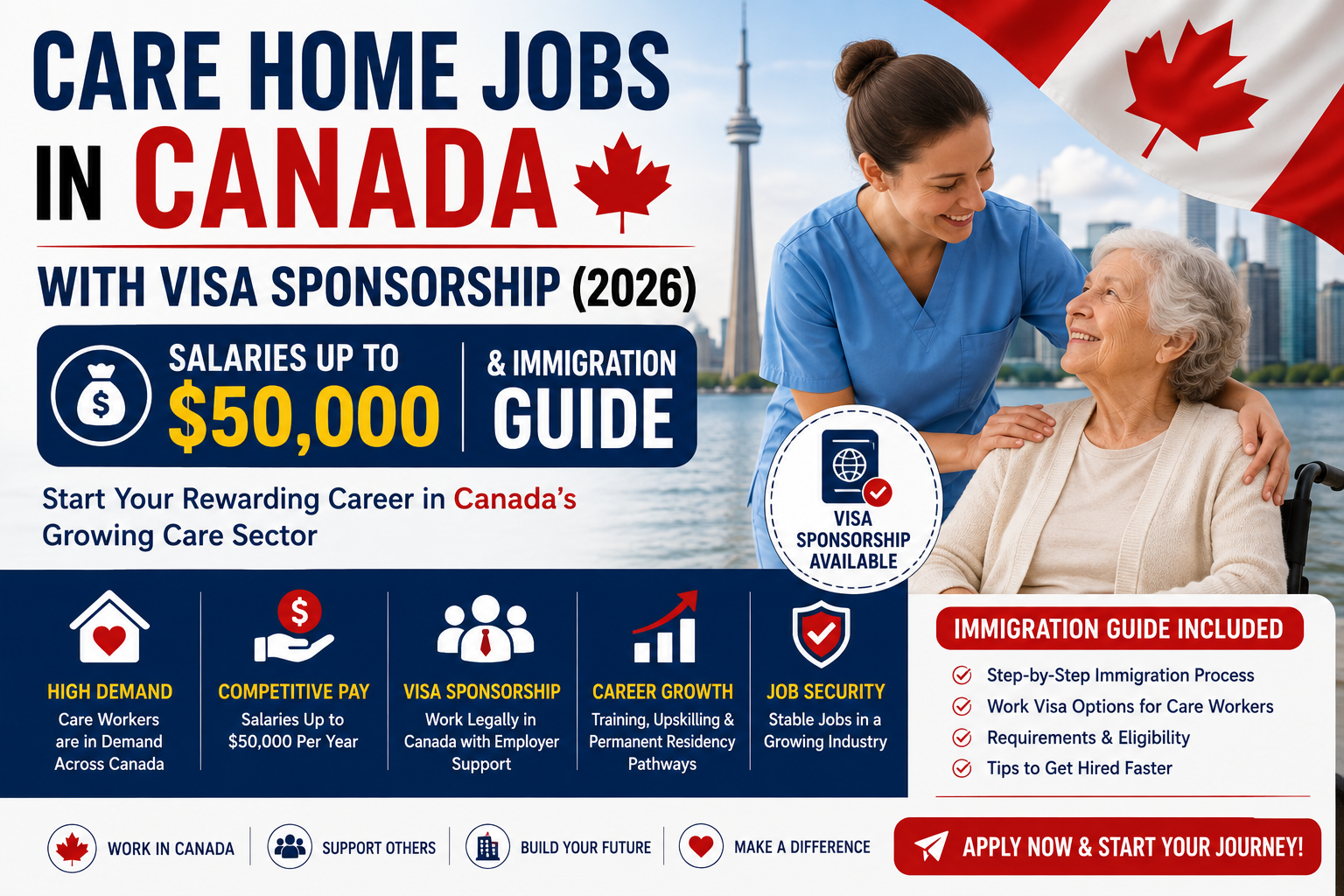
As Canada’s senior population continues to expand, demand for skilled healthcare aides, personal support workers (PSWs), and long-term care assistants has reached unprecedented levels. Canadian care homes, retirement residences, and home-care agencies are actively turning to foreign workers to bridge severe domestic labor shortages, offering competitive compensation, comprehensive benefits, and structured visa sponsorship pathways.
2026 Immigration Update: Employers seeking international talent for institutional care homes primarily utilize the Labor Market Impact Assessment (LMIA) process under the Temporary Foreign Worker Program (TFWP), alongside sector-specific Provincial Nominee Program (PNP) streams tailored for healthcare and community support workers.
1. Why Canada is actively Hiring Foreign Care Workers
Canada’s healthcare infrastructure relies heavily on long-term care homes and assisted-living facilities. With an aging demographic, thousands of openings remain unfilled annually across every province.
-
High Earning Potential: Base salaries range from $18.50 to $26.00+ per hour, allowing full-time staff to earn between $39,000 and $50,000+ annually, with significant additional income possible through overtime pay.
-
Family Inclusion: Foreign care workers entering Canada on employer-sponsored work permits can frequently bring their spouse (eligible for an open work permit) and dependent children.
-
Pathways to Permanent Residency (PR): Gaining Canadian work experience in a licensed care facility opens direct avenues to PR through provincial streams (e.g., Ontario In-Demand Skills, BC Healthcare Professional stream, Alberta Express Entry) and dedicated federal pathways.
2. Primary Job Roles, Responsibilities & Salary Ranges
Care home roles span several job titles depending on the province and facility type. The table below outlines typical roles, National Occupational Classification (NOC) codes, and salary expectations:
| Job Title | NOC Code | Hourly Wage (CAD) | Estimated Annual Earnings | Primary Responsibilities |
| Personal Support Worker (PSW) | NOC 33102 | $20.00 – $25.50 | $41,600 – $53,000 | Personal hygiene assistance, mobility support, medication reminders, monitoring patient vitals. |
| Health Care Aide / Care Attendant | NOC 33102 | $19.00 – $24.50 | $39,500 – $51,000 | Daily living assistance in long-term care facilities, feeding assistance, patient charting. |
| Institutional Caregiver / Support Specialist | NOC 44101 | $18.50 – $23.00 | $38,500 – $47,800 | Companionship, mobility support, assisting residents in group homes and senior living centers. |
| Senior/Lead Care Assistant | NOC 33102 | $23.00 – $27.00+ | $47,800 – $56,000+ | Team oversight, complex patient handling, facility compliance, liaison with registered nurses. |
3. How Visa Sponsorship Works for Care Home Jobs
To hire an international candidate outside Canada, Canadian employers generally follow standard immigration procedures:
[ Step 1: Employer Advertises Job Locally in Canada ]
                        │
                        ▼
[ Step 2: Employer Obtains Positive LMIA from ESDC ]
                        │
                        ▼
[ Step 3: Employer Issues Formal Job Offer & LMIA Number ]
                        │
                        ▼
[ Step 4: Candidate Applies for Employer-Specific Work Permit ]
                        │
                        ▼
[ Step 5: Candidate Relocates to Canada & Begins Employment ]
Key Immigration Pathways
-
LMIA-Backed Work Permit (TFWP): The most common route for institutional care homes. The employer proves to Employment and Social Development Canada (ESDC) that no qualified Canadian was available, securing an LMIA so you can apply for a closed work permit.
-
Provincial Nominee Programs (PNPs): Provinces like Ontario, British Columbia, Alberta, and Saskatchewan have dedicated healthcare streams that prioritize care aides and personal support workers for fast-tracked work permits and PR nominations.
4. Qualifications & Document Checklist
To qualify for an employer-sponsored care home position, foreign candidates must fulfill both job-specific and immigration criteria:
Essential Qualifications
-
Education: Minimum high school diploma (evaluated via an Educational Credential Assessment (ECA) such as WES). Formal caregiving certifications or personal support worker diplomas (6+ month courses) significantly increase job offer prospects.
-
Language Proficiency: Minimum Canadian Language Benchmark (CLB) 4 or 5 in English or French (demonstrated via IELTS General, CELPIP, or TEF).
-
Experience: 6 to 12+ months of documented experience in caregiving, nursing support, or long-term care facilities.
-
Certifications: Valid First Aid and CPR certifications (or willingness to complete Canadian equivalency upon arrival).
-
Clearances: Clean police record check and medical examination clearance.
5. Comprehensive Salary & Benefits Package
Working in a Canadian care home provides perks beyond basic hourly wages:
-
Overtime Rates: Time-and-a-half (1.5x) standard pay for hours worked beyond 8 hours/day or 40 hours/week.
-
Health & Dental Insurance: Extended medical coverage including prescription drugs, dental care, and vision care after a standard probationary period (typically 3 months).
-
Paid Time Off: Statutory holiday pay plus 2 to 3 weeks of paid annual vacation.
-
Relocation Assistance: Select employers offer initial housing setup assistance or airfare allowances to help international hires transition smoothly.
6. Where to Find Sponsored Care Home Jobs
When applying, focus on major national providers and provincial long-term care networks known to recruit internationally:
-
Major Private & Non-Profit Care Providers: Bayshore HealthCare, Revera, Sienna Senior Living, Chartwell Retirement Residences, and Shannex.
-
Official Job Portals:
-
Job Bank Canada (
jobbank.gc.ca): Filter by “Temporary Foreign Workers” or “LMIA Approved.” -
Indeed Canada (
ca.indeed.ca): Search queries like"Personal Support Worker Visa Sponsorship"or"Health Care Aide LMIA". -
Provincial Health Authority Career Pages: Inspect regional health authority listings in provinces like Alberta Health Services (AHS) or BC Health Match.
-
7. Step-by-Step Application Guide
-
Get Credentials Evaluated: Request an ECA for your educational diplomas to prove equivalency to Canadian standards.
-
Take Your Language Test: Complete IELTS General or CELPIP to establish your CLB score.
-
Format Your Canadian-Style Resume: Draft a targeted 2-page resume highlighting clinical care hours, patient transfers, hygiene management, and specialized training (e.g., dementia or Alzheimer’s care).
-
Apply to Verified Employers: Submit applications directly through facility career portals and official government job boards targeting sponsored vacancies.
-
Apply for Work Permit: Upon receiving a signed offer letter and positive LMIA, complete your visa application via the Immigration, Refugees and Citizenship Canada (IRCC) portal.
8. Frequently Asked Questions (FAQs)
Q: Do I have to pay a recruiter for an LMIA or job offer?
No. Under Canadian law, it is illegal for employers or recruitment agencies to charge candidates fees for a job offer or LMIA. Legitimate employers cover all LMIA processing fees themselves.
Q: Can I bring my family with me to Canada on a care home work permit?
Yes. Main applicants on eligible employer-sponsored work permits can include their spouse (who may apply for an open work permit) and dependent children (who can attend public schools).
Q: How long does it take to get a work permit once I receive a job offer?
Once the employer secures a positive LMIA, visa processing times at foreign visa offices typically range between 2 and 6 months, depending on your home country.
Q: Is experience as a nurse in my home country applicable for care home roles?
Yes. Internationally educated nurses (IENs) frequently start as Personal Support Workers or Health Care Aides while completing their Canadian nursing registration exams, earning $40,000 to $50,000+ during the transition.
