
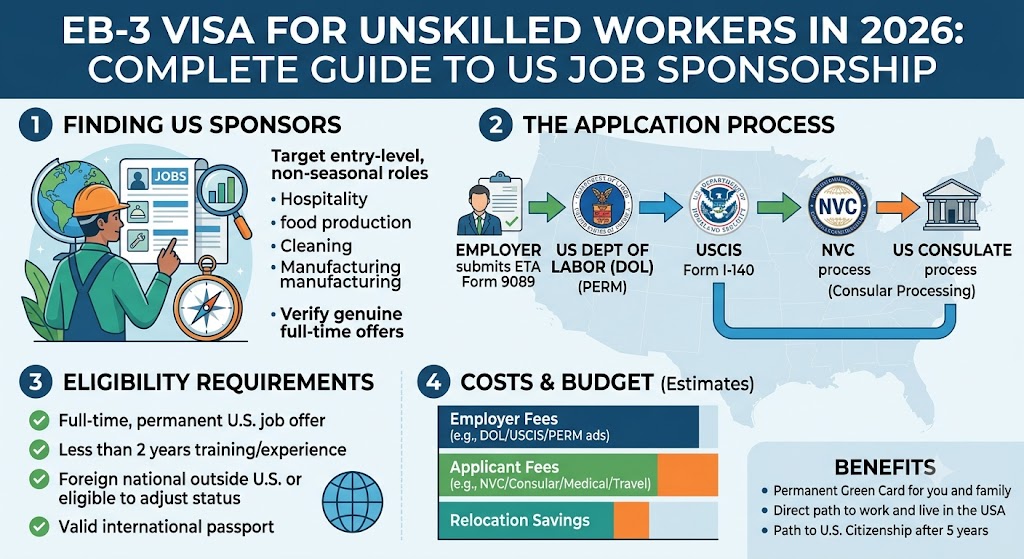
Understanding the EB-3 Unskilled Worker Visa in 2026 is important for foreign nationals exploring employment-based immigration to the United States. The EB-3 category includes an “Other Workers” classification for certain jobs that require less than two years of training or experience.
Unlike a temporary employment visa, an approved EB-3 immigrant visa can lead to lawful permanent residence when all applicable requirements are satisfied. However, the process involves multiple stages, including employer sponsorship, Department of Labor procedures, USCIS petition processing, and—when applicable—consular processing.
This guide explains the EB-3 unskilled-worker pathway, potential costs, eligibility requirements, relocation planning, and the general application process for 2026.
1. WHY CONSIDER THE EB-3 UNSKILLED WORKER VISA IN 2026?
The EB-3 category can provide an employment-based pathway for foreign workers seeking permanent residence in the United States.
The EB-3 Other Workers classification is intended for certain permanent, full-time positions that require less than two years of training or experience and are not temporary or seasonal.
Potential employment opportunities can exist across different industries and locations, including states such as:
- Texas
- California
- Florida
- New York
- Ohio
- Georgia
- North Carolina
Possible job areas may include qualifying positions in:
- Manufacturing.
- Food production.
- Hospitality.
- Agriculture-related employment.
- Warehousing.
- Food service.
- Janitorial and cleaning services.
- Other occupations meeting the applicable EB-3 requirements.
IMPORTANT: An EB-3 Other Worker position must meet specific immigration and labor requirements. Not every low-skilled or entry-level job qualifies for EB-3 sponsorship.
The process is also not simply a job application. It generally requires coordination between the US employer, Department of Labor, USCIS, National Visa Center, and foreign worker.
2. EB-3 OTHER WORKER VISA: KEY FACTS
Before beginning the process, applicants should understand the basic structure of the category.
TARGET APPLICANTS
The EB-3 Other Worker category may apply to foreign nationals with a qualifying permanent US job offer for work requiring less than two years of training or experience.
PATH TO PERMANENT RESIDENCY
Unlike a temporary work permit, an approved employment-based immigrant visa can lead to lawful permanent resident status.
Green cards are generally issued with a 10-year validity period, but lawful permanent residence itself is not limited to 10 years. The card must be renewed when it expires unless the person has already naturalized or otherwise changed status.
Eligible permanent residents may potentially apply for US citizenship after meeting the applicable naturalization requirements, including the required period of continuous residence.
CONSULAR PROCESSING
Applicants living outside the United States generally complete immigrant visa processing through the National Visa Center and a US embassy or consulate designated to process their case.
KEY GOVERNMENT AGENCIES
The process may involve:
- US Department of Labor (DOL)
- US Citizenship and Immigration Services (USCIS)
- National Visa Center (NVC)
- US Department of State
For applicants in Nigeria, the appropriate US consular post and current processing arrangements should be verified directly with the US Embassy or Department of State.
3. EB-3 UNSKILLED VISA COSTS AND BUDGET
The financial responsibilities associated with an EB-3 case can be divided between the sponsoring employer and the foreign worker.
Certain employer-side expenses, particularly costs associated with the PERM labor-certification process, generally cannot be shifted to the sponsored worker.
The following figures reflect the estimates contained in the original guide and should be treated as planning figures rather than guaranteed 2026 fees.
| EXPENSE CATEGORY | TYPICAL RESPONSIBILITY | ESTIMATED COST |
|---|---|---|
| PERM Advertising | Employer | $2,500–$6,000 |
| PERM Attorney Fees | Employer | $2,500–$4,000 |
| Form I-140 Filing | Employer or Applicant, depending on arrangement | $715 |
| Form I-907 Premium Processing | Employer or Applicant where permitted | $2,965 |
| DS-260 Fee | Applicant | $345 |
| Affidavit of Support | Applicant / Employer depending on case | $120 |
| Immigration Attorney — NVC/Consular Stage | Applicant | $2,000–$4,000 |
| USCIS Immigrant Fee | Applicant | $235 |
| Medical Examination | Applicant | $350–$500 |
| Temporary Travel Insurance | Applicant | $100–$200 |
Actual government fees and professional charges can change. Applicants should verify current fees through official USCIS, Department of State, and other relevant government sources before paying.
4. UNDERSTANDING THE EB-3 VISA CATEGORIES
The EB-3 classification contains three main employment-based groups.
EB-3 OTHER WORKERS
This category is for qualifying permanent positions requiring less than two years of training or experience.
EB-3 SKILLED WORKERS
This category applies to positions requiring at least two years of training or experience, provided the worker meets the applicable requirements.
EB-3 PROFESSIONALS
This category generally applies to positions requiring a US bachelor’s degree or foreign equivalent.
EB-2
EB-2 is a separate employment-based preference category generally intended for professionals with advanced degrees or individuals with exceptional ability who meet the applicable requirements.
The correct immigration classification depends on the position and the applicant’s qualifications. Employers should ensure that the sponsored position satisfies the applicable requirements.
5. ELIGIBILITY AND DOCUMENTS REQUIRED
EB-3 eligibility involves both the requirements of the sponsored position and the applicant’s immigration circumstances.
Before proceeding, applicants should prepare accurate civil and immigration documentation.
COMMON DOCUMENTS
Depending on the case, documents may include:
- Valid passport.
- Birth certificate.
- Marriage certificate, if applicable.
- Police certificates.
- Employment documentation.
- Approved Form I-140.
- DS-260 confirmation.
- Medical examination results.
- Educational or professional records where applicable.
- Other civil documents requested by the NVC or consular post.
Applicants should carefully follow the document instructions issued for their specific case.
MEDICAL EXAMINATION
Immigrant visa applicants generally need a medical examination performed by an approved panel physician.
The examination requirements depend on the applicant’s country and immigration case.
FINANCIAL PREPARATION
It can be helpful to prepare a financial reserve for the initial period after arrival.
Applicants may also research:
- Multi-currency financial services.
- Travel insurance.
- Temporary accommodation.
- International money-transfer services.
Examples include Wise, Revolut, Cigna Global, Allianz, and other providers, subject to availability in the applicant’s country.
6. TRAVEL AND RELOCATION AFTER EB-3 APPROVAL
Once an immigrant visa has been issued, the applicant must plan their move to the United States.
Before booking travel, carefully check the visa validity period and admission requirements shown on the issued visa and accompanying documentation.
FLIGHT OPTIONS
Travelers can compare international airfare through platforms such as:
| PLATFORM | SERVICE |
|---|---|
| Skyscanner | Flight comparison |
| Google Flights | Flight search and price tracking |
| Expedia | Flights and travel packages |
| Agoda | Travel and accommodation |
Prices vary depending on departure location, destination, season, baggage, and booking date.
TEMPORARY ACCOMMODATION
New arrivals may use short-term accommodation while searching for permanent housing.
Options can include:
- Booking.com.
- Airbnb.
- Extended-stay hotels.
- Corporate housing.
- Employer-provided accommodation.
Where possible, choose temporary housing with convenient access to your workplace.
7. CONNECTIVITY, INSURANCE AND MONEY MANAGEMENT
Preparing a few basic services before departure can make the transition easier.
TRAVEL INSURANCE
Temporary insurance may be useful during the period before employer-sponsored health benefits begin.
Potential providers include:
- SafetyWing.
- World Nomads.
- IMG.
- Allianz.
Review exclusions, coverage limits, deductibles, and eligibility before purchasing any policy.
ESIM CONNECTIVITY
An eSIM can provide immediate mobile connectivity after arrival.
Services such as:
- Airalo.
- Holafly.
may offer international eSIM options depending on your destination and device.
INTERNATIONAL MONEY TRANSFERS
Workers sending money overseas can compare providers such as:
- Wise.
- Remitly.
- WorldRemit.
- Western Union.
- MoneyGram.
- Xoom.
- Ria.
Compare the exchange rate, transfer fee, delivery speed, and final amount received before sending funds.
8. RELOCATION BUDGET AND COST OF LIVING
Your first few months in the United States may require a larger financial reserve than your normal monthly budget.
Housing costs can vary dramatically between cities.
A worker living in a lower-cost community may have significantly different expenses from someone living in New York, Los Angeles, Miami, or another major metropolitan area.
ILLUSTRATIVE FIRST-MONTH BUDGET
| EXPENSE | BUDGET TRAVELER | COMFORT TRAVELER |
|---|---|---|
| First Month Rent + Deposit | $1,500 | $3,500 |
| Groceries | $300 | $600 |
| Transportation | $200 | $800 |
| Phone, Utilities & Setup | $100 | $250 |
| TOTAL FIRST-MONTH RESERVE | $2,100 | $5,150 |
These are planning examples, not guaranteed costs.
Before relocating, consider the cost of:
- Housing.
- Transportation.
- Food.
- Utilities.
- Mobile service.
- Work clothing and equipment.
- Health insurance.
- Emergency expenses.
- Family support.
9. HOW TO APPLY FOR THE EB-3 UNSKILLED WORKER VISA IN 2026
The initial stages of the EB-3 process are generally employer-driven.
STEP 1: FIND A QUALIFYING EMPLOYER
The process begins with a genuine permanent job opportunity that satisfies the requirements of the EB-3 Other Worker category.
STEP 2: PREVAILING WAGE DETERMINATION
The employer generally obtains a prevailing wage determination from the Department of Labor for the sponsored position.
STEP 3: PERM LABOR CERTIFICATION
For positions requiring PERM labor certification, the employer completes the required recruitment process and files the labor certification application with the DOL.
The employer is responsible for the required PERM recruitment and labor-certification costs.
STEP 4: FILE FORM I-140
After the labor certification is approved, where PERM is required, the employer files Form I-140, Immigrant Petition for Alien Workers, with USCIS.
STEP 5: PREMIUM PROCESSING
Where available and appropriate, premium processing may be requested for eligible I-140 petitions.
Premium processing provides expedited USCIS adjudication under the applicable rules, but it does not guarantee visa availability or final immigration approval.
STEP 6: NATIONAL VISA CENTER
Once the petition is approved and the case is eligible to proceed, the National Visa Center handles the immigrant visa processing stage.
The applicant may need to:
- Complete Form DS-260.
- Submit civil documents.
- Provide financial documentation where required.
- Complete other NVC requirements.
STEP 7: CONSULAR INTERVIEW
Applicants outside the United States generally attend an immigrant visa interview at the appropriate US embassy or consulate.
STEP 8: MEDICAL EXAMINATION
The applicant completes the required medical examination with an approved panel physician.
STEP 9: VISA ISSUANCE AND US ENTRY
If the immigrant visa is approved, the applicant can make travel arrangements and enter the United States according to the instructions associated with the visa.
10. FREQUENTLY ASKED QUESTIONS
HOW MUCH DOES THE PERM PROCESS COST THE EMPLOYEE?
The sponsored worker generally should not be required to pay the employer’s PERM labor-certification costs.
Employer-side PERM recruitment and attorney expenses are generally the responsibility of the sponsoring employer under the applicable rules.
Applicants should be cautious if an employer or recruiter asks them to pay costs that legally must be covered by the employer.
CAN I PAY FOR I-140 PREMIUM PROCESSING?
Where premium processing is available for the specific petition, the applicable rules determine who may submit and pay for the request.
Confirm the current USCIS requirements and fee before making payment.
WHAT TRAVEL INSURANCE CAN I USE BEFORE EMPLOYER BENEFITS BEGIN?
You can research temporary international health or travel insurance from providers such as Allianz, IMG, or SafetyWing.
However, policies differ considerably, so review the coverage carefully before purchasing.
HOW CAN I SEND MONEY BACK HOME AFTER MOVING TO THE US?
Compare international transfer providers based on their total exchange rate, fees, transfer limits, and delivery times.
Potential services include Remitly, Wise, WorldRemit, Western Union, MoneyGram, Xoom, and Ria.
WHAT IF I HAVE A PREVIOUS US VISA OVERSTAY?
A previous overstay or other immigration violation can have serious consequences for future US immigration applications.
Depending on the circumstances, unlawful presence may result in immigration bars.
Applicants with previous visa violations should seek advice from a qualified US immigration professional before proceeding.
DO I NEED A MULTI-CURRENCY CARD?
It can be useful for managing initial expenses, particularly before you establish full access to US banking services.
However, availability, fees, exchange rates, and features vary by provider and country.
HOW LONG DOES CONSULAR PROCESSING TAKE?
There is no single processing time for every EB-3 applicant.
The timeline can depend on:
- Visa availability.
- Priority date.
- USCIS processing.
- NVC processing.
- Consular appointment availability.
- Document completeness.
- Security and administrative processing.
Applicants should check current Department of State and NVC information rather than relying on a fixed timeline.
HOW MUCH SHOULD I BUDGET FOR LEGAL FEES?
Legal fees vary considerably based on the attorney, case complexity, employer arrangement, and stage of representation.
The original guide estimates total attorney costs of approximately $6,000–$10,000 or more, but this should be treated as a general planning estimate rather than a standard market price.
11. FINAL STEPS FOR PROSPECTIVE EB-3 OTHER WORKERS
The EB-3 Other Worker category can provide a pathway toward US permanent residence for eligible foreign workers with qualifying employment opportunities.
However, the process can take considerable time and involves multiple government agencies and procedural requirements.
Before accepting an offer, applicants should:
- Verify that the employer is legitimate.
- Confirm that the position is genuinely permanent and full-time.
- Understand whether PERM is required.
- Confirm who is responsible for each immigration expense.
- Review the employment contract carefully.
- Keep all civil documents accurate and complete.
- Monitor the Visa Bulletin.
- Follow USCIS and NVC instructions.
- Avoid recruiters promising guaranteed green cards or guaranteed visa approval.
- Seek qualified immigration advice when the case is complex.
The most important step is to understand the difference between a genuine employer-sponsored opportunity and a recruitment offer that simply promises immigration assistance.
A legitimate EB-3 case requires a qualifying job, a compliant employer, accurate documentation, and successful completion of the applicable immigration process.
Always verify current USCIS, Department of Labor, Department of State, and NVC requirements and fees before making financial or immigration decisions.
If you want, I can also turn this into a more aggressive SEO version targeting keywords such as “EB-3 unskilled jobs 2026,” “EB-3 visa sponsorship jobs,” “EB-3 unskilled jobs for foreigners,” and “EB-3 green card without degree.”
